Published July 19, 20263 min
Building a Multi-Channel Inbox: Email, Chat, and Widget in One Thread

TL;DR
A support widget is a guest inside thousands of other sites' hostile CSS. Rendering in a Shadow DOM kills inherited-style chaos, class collisions, and reset wars — at the real cost of font-loading workarounds, focus-API quirks, and tougher testing. It is the middle ground between a fragile bare embed and a heavyweight iframe.
A support widget is a guest in someone else's house. It gets injected into pages with aggressive CSS resets, !important rules on *, right-to-left layouts, dark-mode overrides, and at least one z-index: 2147483647 banner. The naive iframe-free embed breaks somewhere new every week.
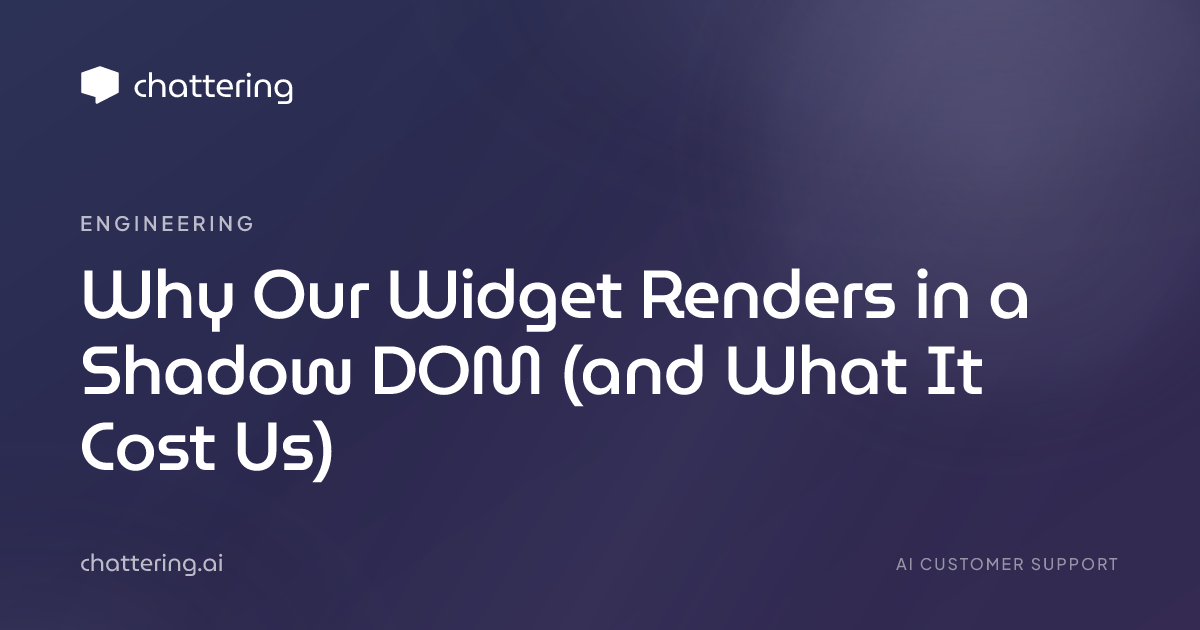
We render the Chattering widget inside a Shadow DOM. Here is the honest accounting.
Shadow DOM gives the widget its own style scope: host-page selectors cannot reach in, and our styles cannot leak out. Concretely, that killed the three recurring bug classes from our early betas:
line-height: 2 or global button { border-radius: 0 } restyling our composer.The launcher bubble, panel, and every message render identically on a brutalist marketing page and a dense React dashboard. That predictability is the product.
None of this is free, and anyone selling Shadow DOM as painless has not shipped one:
@font-face must be declared in the host document, not the shadow root. We inject a tiny host-level stylesheet for the font and keep everything else inside.document.activeElement reports the host element, not the focused input inside. Keyboard-navigation code needs shadowRoot.activeElement awareness throughout.The tempting shortcut is a full iframe. It gives even harder isolation — but costs you resize jank on mobile keyboards, a second document for screen readers, cross-frame messaging for everything, and a visible white flash on slow connections. For a widget that opens forty times a day on your busiest page, those seams show.
Shadow DOM sits in the middle: real isolation, native scrolling, one document for accessibility. The cost lands on us at build time instead of on your customers at run time — the right side of the trade.
The isolation work is the front half of the story. The back half is where widget messages end up. They don't go to a separate chat inbox — they arrive as channel-tagged entries in the same conversation object that holds email and any future channels the team adds. A customer can start in the widget, follow up by email, and reply again from the widget three days later; the thread stays continuous.
That's the reason the widget is a one-channel-among-several design from the start, not a standalone chat product bolted to a separate inbox. The Shadow DOM isolation handles embedding on any host page; the unified thread model handles what happens to those messages on the server.
How conversations stay unified across channels →
The widget is a two-line embed; the isolation work is why it stays a two-line embed on your stack too. See it running on this site — the bubble in the corner is the production build.
Iframes give harder isolation but cost resize jank on mobile keyboards, a second document for screen readers, and a white flash on slow connections. Shadow DOM keeps one document with real style isolation.
No — host-page selectors can't reach into the shadow root, and widget styles can't leak out. Aggressive resets and !important rules on your side don't affect it.
@font-face doesn't cross the shadow boundary, so the font is declared in the host document while everything else stays inside.
Not directly — the shadow root is sealed. The widget exposes an event API for the interactions worth tracking.